Widely Held Myths Undermine Traditional Market Research and Innovation Processes
We Redefine ‘Voice of the Customer’ and Unleash True Customer Insights to Drive Innovation Strategy
Myth: Customer-centricity means that gathering customer data is the focus of the research
Merely focusing on customers can lead to superficial insights and may miss their motivations and underlying beliefs.
Reality: True customer-centricity means understanding beyond what customers say
We aim to also understand what customers do, think, and feel, as well as understanding the ‘jobs’ they are trying to accomplish.
Myth: Opportunities spawn by asking customers what they like or dislike about existing solutions
Relying solely on this information misses the deeper reasons behind customer behaviors. Customer feedback on existing products can lead to incremental improvements while missing the fundamental reasons customers choose a product.
Reality: Opportunities arise from insights into customers’ motivations and abilities – unbiased by current solutions
Our JTBD framework detaches itself from any specific product or service, focusing instead on identifying unmet needs first, then ascertaining how current or potential solutions can address them. We decouple process and outcome,
Myth: Innovation happens through epiphanies
The belief that innovations suddenly emerge as groundbreaking revelations can lead to unrealistic expectations about the innovation process and overlooks its need to align the actions of multiple functional groups.
Reality: Innovation is a continuous, iterative process
We focus on understanding what customers want, don’t want, and why. This is an iterative processes involving continuous discovery, opportunity assessment, experimentation, refinement and solution development, countering the idea of sudden epiphanies.
Myth: Innovation is the domain of special geniuses
The notion that significant innovations are typically the work of lone inventors or visionary geniuses overlooks the collaborative and cumulative nature of most innovations while also narrowly defining innovations only as major breakthroughs
Reality: Innovation is a collaborative effort
Our approach inherently involves collaboration, requiring diverse insights to understand and meet customer needs effectively. We align the actions of marketing, R&D, sales, corporate development, and strategy around a common understanding of customer needs.
Myth: It’s hard to find good ideas
The perception that truly good ideas are rare can discourage efforts to seek and develop new ideas. It also risks equating “good” with “disruptive” when in fact a good innovation is one that addresses an unmet need, however mundane it may seem.
Reality: The real challenge is prioritizing many ideas
We emphasize the importance of aligning ideas, execution and timing with customer needs and the current market, ensuring confidence and improving the chances of success.
Myth: The best ideas win
The assumption that the most outstanding ideas will naturally succeed overlooks the role of execution, market timing, and other factors in the success of an idea.
Reality: Go-to-market success is multi-factorial
We emphasize the importance of aligning ideas, execution and timing with customer needs and the current market, ensuring confidence and improving the chances of success.
Myth: There is a formulaic method for innovation
The idea that there’s a foolproof, step-by-step method for achieving innovation risks undue rigidity and can limit creativity and adaptability.
Reality: Innovation requires flexibility and adaptability
We focus on understanding what customers want, don’t want, and why. This is an iterative processes involving continuous discovery, opportunity assessment, experimentation, refinement and solution development, countering the idea of sudden epiphanies.
Myth: Customers love new ideas
Conventional belief that new ideas are always welcomed and embraced can lead to unrealistic expectations about the acceptance and success of innovations.
Reality: New ideas need to fulfill Jobs-to-be-Done
New ideas often face resistance due to comfort with the status quo or fear of change. We identify customers’ needs and contexts, ensuring that new ideas are relevant and more likely to be accepted.
We overcome the failings of traditional customer research and discovery.
We focus on grasping the motivations and capabilities that drive customers to achieve a Job-to-be-Done.
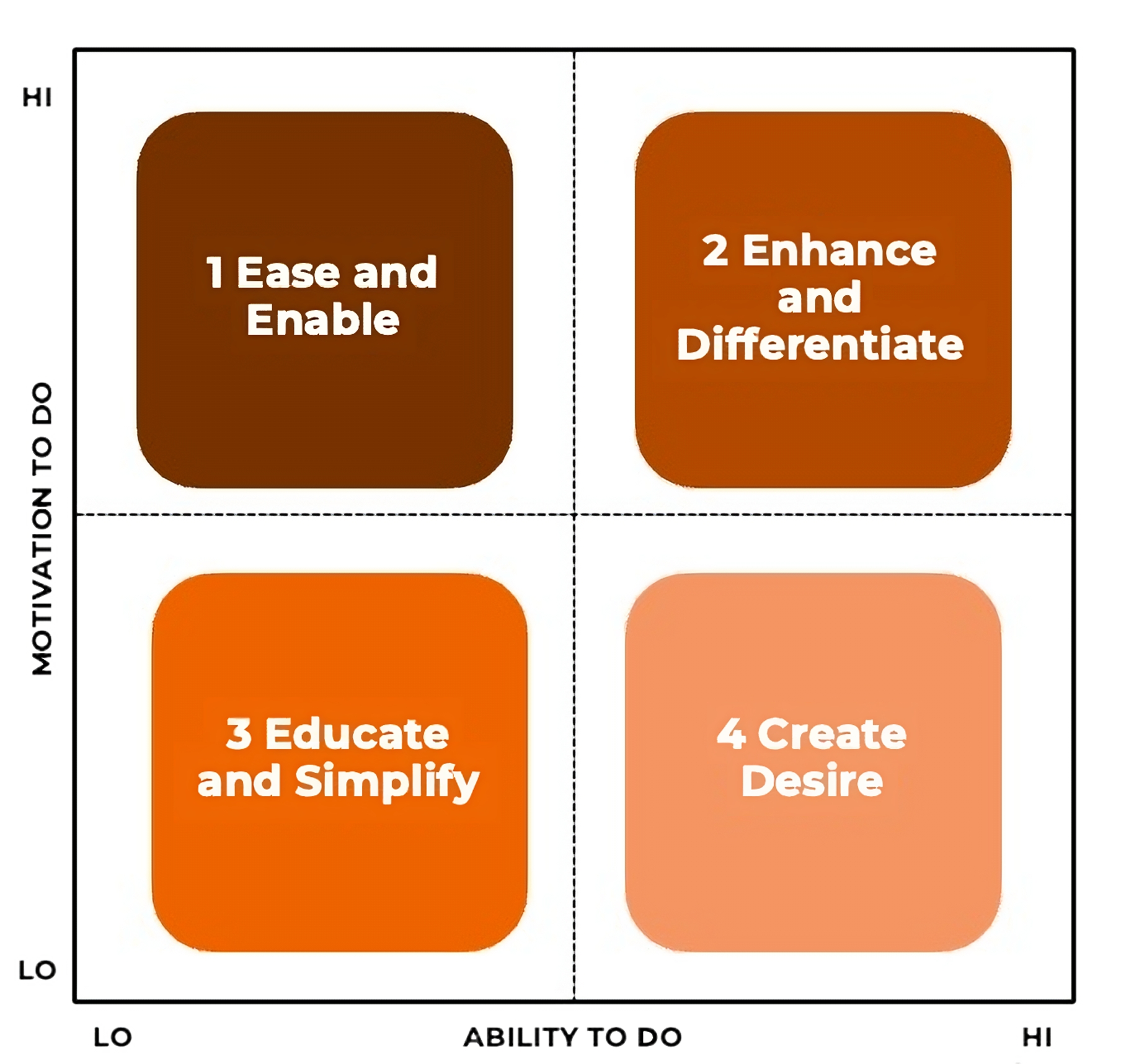
- We map motivations vs. abilities to reveal true unmet needs.
- We create more actionable customer segmentation based on unmet needs with shared characteristics.
- We ideate, test, refine and develop innovative solutions to address the needs of each segment.
Uncovering Unmet Needs through JTBD
The Opportunity Matrix
1. Ease & Enable
Customers are highly motivated but face complex challenges.
Prime targets for disruptive innovation.
Simplifying these tasks can lead to market transformation and significant value creation.
2. Enhance & Differentiate
Tasks are easy and desirable in a competitive market.
Essential for standing out in saturated markets.
Success hinges on adding unique features or reimagining the user experience to differentiate from competitors.
3. Educate & Simplify
Customers are less inclined to engage in these challenging jobs.
Opportunity lies in simplifying these tasks and educating customers about their benefits, thereby increasing motivation and adoption.
4. Create Desire
Jobs are straightforward but lack appeal.
Focused on sparking customer interest.
Innovators can create new demand by repositioning these jobs or enhancing their attractiveness through innovative marketing or additional features.